
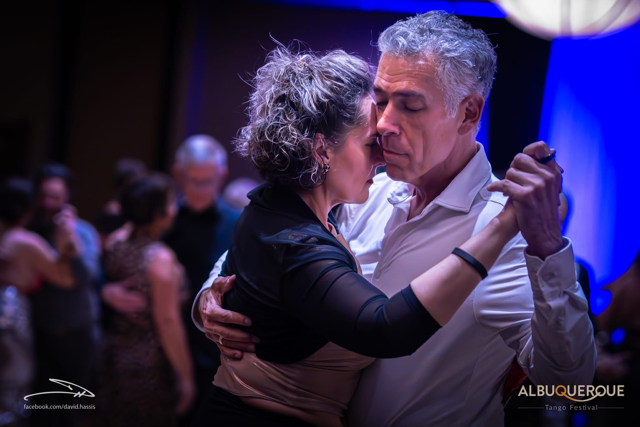
Erskine Maytorena has spent his life chasing rhythm in all the places it hides—on opera stages, in orchestra pits, inside the bellows of a bandoneon, and most stubbornly, inside the bodies of dancers who swear they are “not musical.” He began as an opera singer, where rhythm wore formal attire and followed the rules. Then tango arrived, loosened his bow tie, and proved to him that rules are just suggestions and that everything sounds a bit better with a little swing. Even opera.
He founded a tango orchestra in 2008 and eventually placed third in the Che Bandoneon Competition—an accomplishment made more surprising by the fact that he had already stepped away from performing to focus on family, teaching, and understanding why tango’s rhythm feels so natural to some dancers and so elusive to others. Years of studying Golden-Age orchestras convinced him that most problems in musicality can be solved not with talent, but with clear patterns, simple exercises, and the kind of repetition human beings are built for.
His work crosses boundaries—music, movement, learning theory, neurology, and the small practical frustrations that accompany anyone who tries to master difficult things later in life. Erskine writes about timing, systems, and the invisible structures that shape human performance. His work often begins with a simple observation: important things are frequently measurable long before they are widely understood.
That conviction did not emerge from art alone. Before his life in performance and writing, he served in the United States Air Force as a crew chief on F-4 Phantom fighter aircraft. In that world, rhythm took the form of checklists, tolerances, and systems discipline. Missed data was not theoretical. Mistakes could be fatal. The lesson endured: complex systems rarely fail loudly at first. They drift. And if you measure carefully, you see the drift long before you feel the collapse.
He is drawn to tools and ideas that exist quietly at the margins—technically sound, underused, and waiting to be translated into practical language. The Brain Gauge entered his life almost incidentally. While exploring neuromodulation technologies and research tools related to PEMF and LENS, he acquired one without fully grasping its implications. Only later, during his own neurological disruption—when reading, movement, and cognitive clarity became unstable—did he return to it with different eyes. What had seemed like a research instrument began to look like something more fundamental.
The question shifted from “What does this measure?” to “Why isn’t anyone using this?”
That shift became the foundation of his work on cortical timing.
Before turning fully to writing, Erskine spent decades in performance. He later taught Argentine tango, where timing is not a theory but something negotiated in real time between two nervous systems. He studied Traditional Chinese Medicine at the International Institute of Chinese Medicine in Albuquerque, where his interest in systems thinking deepened—particularly the idea that complex outcomes often arise from subtle imbalances in rhythm and coordination.
Today, he writes. His work bridges neuroscience, performance, and systems thinking, translating research on temporal processing into practical frameworks that individuals can use to observe and improve how they function. He has written extensively on measurement, feedback loops, and the importance of identifying leverage points others overlook.
Erskine lives in Albuquerque with his family, where he continues to explore the architecture of tango, the mysteries of timing, and the engineering flaws of the bandoneon, which seem specifically designed to undermine the confidence of otherwise competent adults.